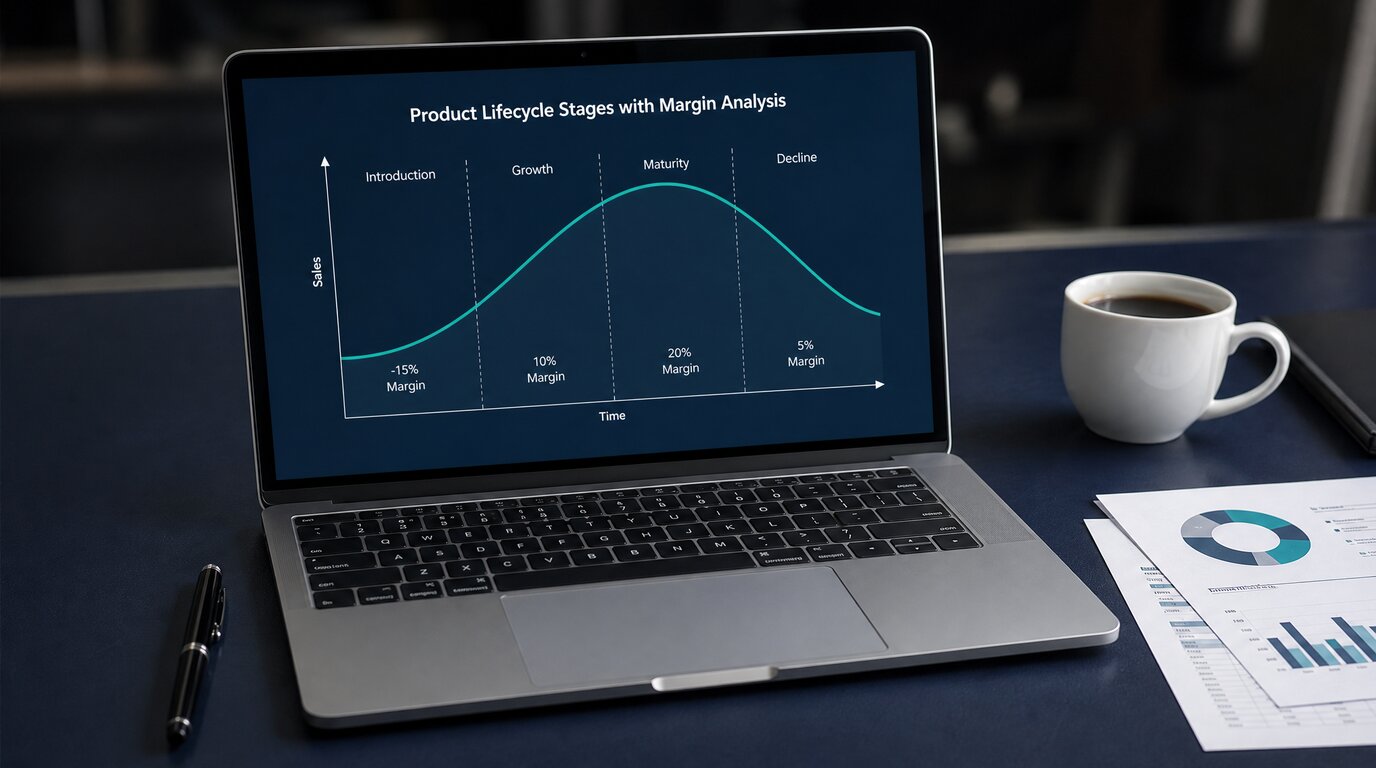
Margin compression rarely arrives as a sudden event. It arrives as a pattern, a slow migration that is visible in hindsight but almost always missed in real time. By the time leadership identifies it, the pricing power that supported earlier growth is already gone, and the decisions that might have protected margin have already been made by default rather than by design.
The Product Life Cycle framework, introduced by Theodore Levitt in the Harvard Business Review in 1965, remains one of the most practically useful strategic tools available to executive teams navigating growth. Not because it is original or counterintuitive, it is neither, but because most companies are not using it to make financial decisions in real time. They are using it, if at all, as a retrospective explanation.
Understanding Where Your Product Sits on the Curve
Every product or service offering moves along a curve from custom to commodity. In the early phase, when the offering is differentiated, the competitive set is thin, and the market is still learning the category, margins are high and pricing power is strong. As the market matures, more competitors enter, differentiation narrows, and pricing pressure intensifies. The product migrates from custom toward value-added toward commodity, and at each stage, the margin structure and the commercial motion required to win change fundamentally.
The mistake most growth-stage companies make is not recognizing which phase each product or service is in, and therefore not adjusting financial expectations, investment allocation, or competitive strategy accordingly. A product in the value-add phase is being managed as though it still commands custom margins. A product approaching commodity status still has the cost structure of a differentiated offering. Both situations erode margin faster than the P&L makes visible.
The Financial Decision That Follows
Mapping your product portfolio against the life cycle curve is not a marketing exercise. It is a financial planning discipline. The questions it surfaces are CFO-level questions: Which offerings are generating the margin that funds investment in next-generation development? Which are declining toward commodity and require cost structure reduction to remain competitive? Which new categories represent the best opportunity to restore the pricing power the portfolio is losing elsewhere?
These questions connect directly to how capital is allocated, where R&D investment is concentrated, and how the sales and pricing strategy should evolve over the next twelve to eighteen months. Without the framework, these decisions get made piecemeal. With it, they become part of a coherent financial strategy.
What This Looks Like in Practice
In my eight years at Tosco Corporation, which grew from a single refinery to the largest independent oil refiner and marketer in the United States through a disciplined strategy of mergers and acquisitions, the ability to assess where specific products and market segments sat on the maturity curve was central to every capital allocation decision we made. The same analytical discipline applies at the growth-stage company level, even without the M&A context. The principle is identical: invest behind products with pricing power, manage costs aggressively behind products losing it, and develop the next generation before you need it.
Understanding where your products sit on the life cycle curve, and what it means for your margin strategy, is a conversation Upfront Clarity is equipped to have. Reach out at www.upfrontclarity.com or call (203) 530-1180 to start a free conversation.
Product Life Cycle framework: Theodore Levitt, “Exploit the Product Life Cycle,” Harvard Business Review, November to December 1965.